
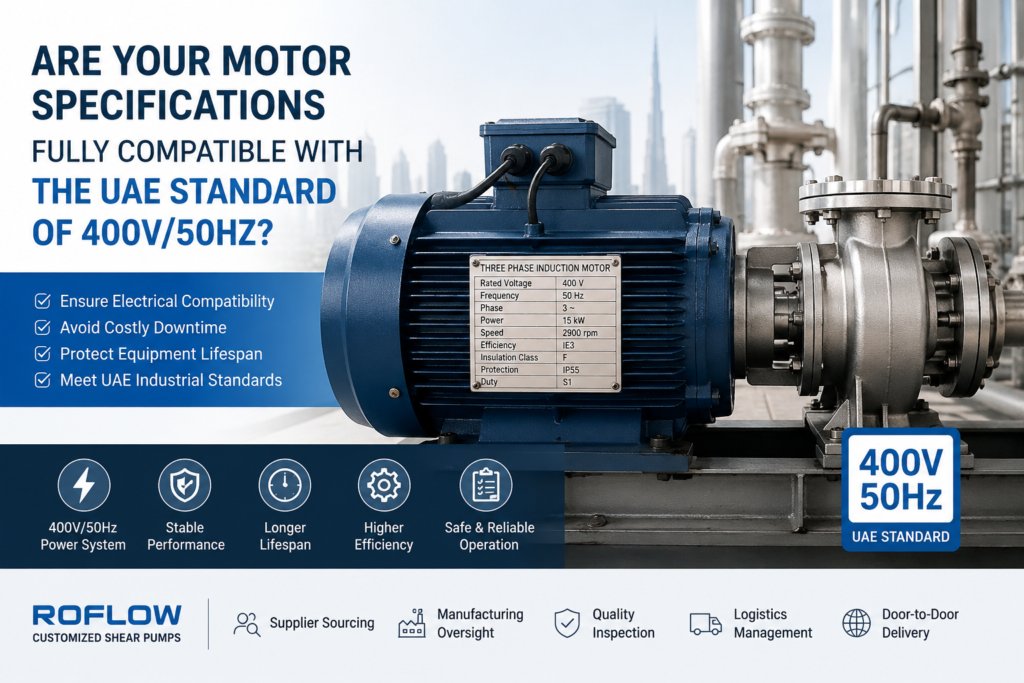
For international buyers, pump performance is only half the story. The bigger risk is often electrical mismatch: the pump arrives on site, but the motor does not match the local power supply.
In the UAE, many industrial facilities use a 400V / 50Hz three-phase system. That sounds straightforward, but in real projects the details matter: voltage tolerance, frequency, insulation class, enclosure rating, ambient temperature, starting method, and whether the motor will run directly on line or through a VFD.
If any of these points are missed, the result can be very expensive: failed startup, nuisance tripping, overheating, reduced efficiency, or even motor replacement after delivery.
For manufacturing plants, water treatment projects, food factories, chemical plants, and oil & gas applications, electrical compatibility should be confirmed before production starts, not after the equipment reaches the job site.
What Electrical Standards Should I Confirm Before Ordering?
Before approving drawings or releasing a PO, your engineering or procurement team should verify the full motor specification, not just the voltage.
A typical industrial pump motor specification should include:
| Item | Typical UAE Requirement |
| Rated Voltage | 400V (Three Phase) |
| Frequency | 50Hz |
| Number of Phases | 3 Phase |
| Motor Efficiency | IE3 or IE4 (depending on project) |
| Protection Rating | IP55 or higher |
| Insulation Class | Class F |
| Temperature Rise | Class B or F |
| Ambient Temperature | Up to 50°C if required |
| Duty Rating | Continuous Duty (S1) |
| Explosion Protection | ATEX / IECEx if hazardous area |
In many EPC and industrial projects, buyers also need to confirm:
Motor brand or approved manufacturer list
- Frame size and mounting dimensions
- Shaft diameter and key size
- Terminal box position and cable entry direction
- Bearing type and lubrication method
- Thermal protection (PTC, PT100, or thermal switch)
- VFD compatibility and inverter-duty design
- Anti-condensation heater, if the site has high humidity or long idle periods
The earlier these details are confirmed, the fewer drawing revisions, delays, and site problems you will face later.
Can the Motor Be Customized for Different Voltage Requirements?
Yes.
Most industrial shear pumps can be supplied with motors configured for different national electrical systems.
Common options include:
Besides voltage and frequency, manufacturers can usually customize:
- Motor brand
- IE efficiency level
- Flange dimensions
- Shaft size
- Protection class
- Thermal sensors
- Variable Frequency Drive (VFD) compatibility
- Stainless steel motor housing for hygienic applications
- Tropicalized winding or anti-corrosion coating for harsh environments
If your project has a fixed electrical standard, the motor should be selected accordingly before production begins. Once the motor is manufactured, changing the electrical configuration is usually costly and may require replacing the motor entirely.
How Do Voltage Mismatches Impact Equipment Lifespan?
Electrical mismatch is not a minor issue. It directly affects motor temperature, efficiency, and service life.
Even a small deviation in voltage or frequency changes how the motor behaves under load.
Higher Operating Temperature
If the voltage is too low, the motor draws more current to maintain torque. That extra current creates more heat in the windings.
If the voltage is too high, insulation stress increases and winding life can be shortened.
A widely accepted rule in motor engineering is that every 10°C increase in operating temperature can reduce insulation life by about 50%. That is why thermal margin matters so much in continuous-duty industrial applications.
Reduced Pump Performance
Frequency mismatch changes motor speed.
For example, a 2-pole motor typically runs at:
- About 2,900 rpm at 50Hz
- About 3,500 rpm at 60Hz
That speed change affects:
- Rotor tip speed
- Shear rate
- Flow capacity
- Pressure
- Power consumption
For shear pumps, this is especially important because speed directly influences particle size reduction and product consistency. Even a small change can affect process results.
Higher Energy Consumption
When a motor runs outside its intended design point, efficiency usually drops.
Over thousands of operating hours per year, even a small efficiency loss becomes real money. For continuous-duty pumps, a 2% to 5% efficiency gap can create a noticeable increase in electricity cost over the life of the equipment.
Unexpected Downtime
Incorrect electrical specifications can lead to:
- Frequent overload trips
- Bearing overheating
- Seal failure
- Premature winding damage
- Production interruptions
For plants where one pump supports an entire process line, one failed motor can stop production and create losses that are far greater than the cost of selecting the correct specification from the start.
What Information Should My Electrical Team Review Before Installation?
Before energizing the pump, your electrical team should compare the motor nameplate with the actual site power supply and installation conditions.
A practical checklist includes:
- Rated voltage matches site voltage
- Frequency matches the local electrical system
- Correct phase sequence
- Motor rotation direction verified before coupling
- Cable size meets current requirements
- Proper grounding connection
- Protection devices correctly sized
- Starter type confirmed (DOL, soft starter, or VFD)
- VFD parameters configured correctly, if applicable
- Ambient temperature within motor rating
- Motor insulation resistance tested before startup
If the pump is installed in a harsh environment, the team should also confirm:
- IP rating is suitable for dust, moisture, or washdown
- Terminal box orientation allows safe cable routing
- Cable glands are correctly selected
- Hazardous-area certification is valid, if required
- Motor cooling is not blocked by surrounding equipment
These checks take little time, but they can prevent many of the most common commissioning problems.
Engineering Support from ROFLOW
At ROFLOW, motor selection is treated as part of the full pump engineering process—not as a standard catalog choice.
Before production begins, our engineering team reviews your project documentation, including:
- Electrical specifications
- Process conditions
- Installation environment
- Required certifications
- Available power supply
- VFD requirements
- Local operating standards
Only after these details are confirmed do we release the manufacturing drawings for customer approval.