
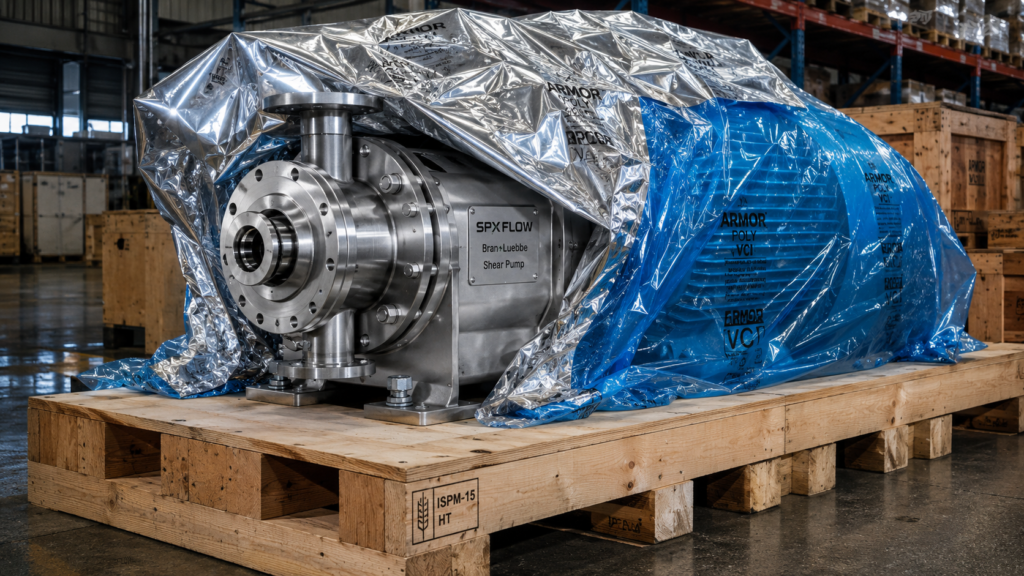
Let’s be direct: buying a precision-engineered custom shear pump is only half the battle. If your supplier treats ocean freight to the Middle East like a domestic delivery, your equipment will arrive as a rusted, electronically dead piece of scrap.
During a 30-day transit from a Chinese port to Jebel Ali or Dammam, temperatures inside a steel shipping container can swing from 20°C at night to a blistering 70°C (158°F) during the day. This extreme temperature fluctuation, combined with high-salinity ocean air, creates a phenomenon called “container sweat.”
At ROFLOW, we don’t rely on hope. Here is our exact engineering and packaging protocol to guarantee your custom shear pump arrives in the UAE in plug-and-play condition.
What Anti-Corrosion Measures Are Applied Before Packaging?
A standard factory wipe-down is useless against 30 days of salt air exposure. Before any pump goes into a box, we execute a strict anti-corrosion protocol:
How Do You Protect Electrical Components Against Condensation?
“Container sweat” literally rains saltwater inside the shipping container. If this moisture breaches your Variable Frequency Drive (VFD) or PLC control panel, the microchips will short-circuit the moment you power them up on site.
Which Packaging Materials Are Best for Long-Distance Sea Freight?
Standard raw wood crates absorb moisture and invite customs delays. We engineer the exterior packaging to withstand both port handling shocks and strict UAE customs inspections.
How Can I Inspect the Equipment Upon Arrival to Verify Protection Quality?
We believe in total transparency. When your logistics team receives the crate in the UAE, you don’t have to guess if the packaging held up. We provide physical indicators so you can verify the integrity immediately:
- Check the HIC (Humidity Indicator Card): Inside the vacuum-sealed electrical bags, we place a visible Humidity Indicator Card. If the dots are blue, the electronics are perfectly dry. If the 50% dot has turned pink, moisture has breached the seal.
- Inspect the ShockWatch Labels: We apply impact-indicator stickers to the exterior crate. If the container was dropped or severely mishandled by the port cranes, the vial will turn red, giving you immediate leverage to file an insurance claim before you even open the box.
Don’t let cheap packaging destroy expensive engineering. If your current Chinese supplier isn’t providing this level of supply chain protection, your delivery timelines are at severe risk.
Don’t leave your pump’s survival to chance.
Download the exact ROFLOW Pre-Shipment Inspection Checklist. We use to audit Chinese CNC tolerances and ocean freight packaging.