
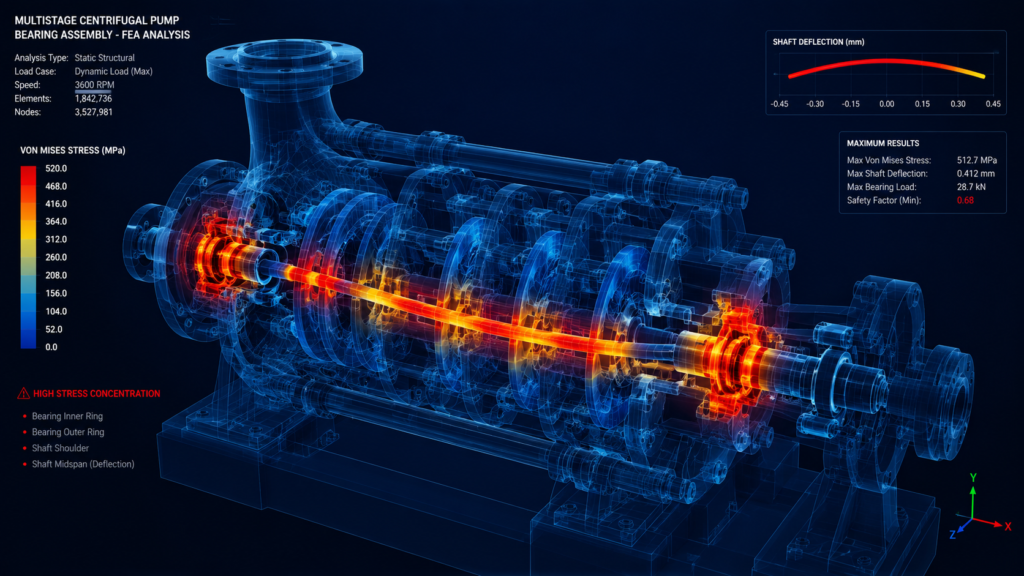
You invest in a heavy-duty centrifugal pump, and the manufacturer’s manual proudly claims a bearing life of “50,000 hours.” But just six months later, the pump is screaming, the bearing is shredded, and your production line is down. Sound familiar?
Traditional fatigue life theory assumes that bearing life is dictated solely by the load it carries and its operating speed. This outdated assumption leads to a massive gap between the “calculated life” on paper and the actual life on your factory floor. As an independent fluid engineering consultant, I am opening the black box to show you exactly how heavy-duty pump bearings actually die—and why buying a “cheap” pump guarantees a premature death.
The Shocking Truth: Only 9% Survive
Here is a hard truth from the industrial field: only about 9% of bearings actually survive long enough to reach their material fatigue limit or designed life.
So, what is killing the other 91%? The reality of early failure comes down to the pump’s manufacturing and operating environment. Roughly 80% of premature bearing deaths are caused by poor lubrication and improper assembly. When budget suppliers cut corners on CNC machining, it leads to misaligned installations and tilted shafts, which subject the bearing to lethal unbalanced loading. Another 10% are destroyed by harsh external factors, including high temperatures, excessive vibration, and corrosive contamination.
The Invisible Killers: Micro-Contamination and Film Collapse
In a high-speed pump, elastohydrodynamic (EHD) lubrication dominates the metal surfaces. A thick, stable oil film is the absolute key to limiting metal-on-metal friction and preventing fatigue.
However, if even a microscopic piece of debris breaches a poorly designed bearing housing, it creates microscopic dents on the bearing raceway. As the rolling elements crash over these dents at 2900 RPM, it causes extreme stress concentration, triggering rapid fatigue cracks and flaking. Furthermore, if even a small amount of moisture infiltrates the housing, the bearing’s fatigue life drops significantly. If the lubrication is inadequate, even the most expensive bearing materials in the world cannot save the pump from a shortened lifespan.
The Metal’s DNA: Why “Cheap” Bearings Are Doomed
Never just look at the brand name stamped on the bearing; look at its metallurgical DNA. The quality of the material itself accounts for over 80% of the impact on a bearing’s lifespan.
The hidden enemies inside cheap steel are oxygen and non-metallic inclusions, which serve as the primary breeding ground for fatigue cracks. Top-tier bearing manufacturers utilize advanced techniques like vacuum degassing or electroslag remelting to drastically reduce oxygen content. This single, invisible material upgrade can extend a bearing’s life by 10 times—or even dozens of times—compared to the standard electric furnace steel used by budget pump suppliers.
The Modern Engineering Approach
Modern bearing theory dictates that calculating true life requires adding specific correction factors for reliability, material quality, and operating/lubrication conditions.
The modern modified life equation looks like this:
$$L_{nm} = a_1 \times a_2 \times a_3 \times L_{10}$$
The incredible truth is that if a pump is engineered to provide a highly clean housing environment, with adequate EHD lubrication, and the actual load remains below its fatigue load limit, the bearing’s fatigue life can actually become infinite, transitioning eventually into a slow, predictable wear life.
Protect Your Rotating Assets
Stop paying for a “calculated life” that you will never see. When you partner with ROFLOW, we audit the entire ecosystem of the pump before it ships. We verify the foundry’s CNC machining tolerances to eliminate shaft misalignment, audit the bearing housing seals to ensure zero water ingress, and demand high-purity degassed steel bearings.