
Introduction
Selecting fluid equipment requires strict adherence to system requirements to ensure facility energy management and optimal operations.
For industrial mechanical engineers, facility managers, B2B procurement officers, and water treatment system designers, specifying an oversized centrifugal pump creates severe technical and financial consequences.
This guide provides objective diagnostic criteria and actionable sizing solutions to maximize system reliability and efficiency, helping professionals prevent or correct the impacts of pump oversizing.
Pain Point: The Hidden Costs
Why Do Oversized Pumps Waste Energy and Increase Operating Costs?
An oversized pump acts as a long-term financial drain on facility operations. The primary pain points associated with oversized fluid equipment include:
Excessive Energy Consumption: An oversized pump uses significantly more electricity than a properly sized unit.
Skewed Life Cycle Cost (LCC): The lifetime energy waste and elevated maintenance costs of an oversized pump far outweigh the initial purchase price.
Inefficient Flow Management: Using a throttling valve to manage excess capacity introduces artificial system resistance, causing the pump to consume high amounts of energy to overcome friction.
Engineering Analysis
Understanding fluid dynamics is essential for proper pump sizing. Mechanical engineering principles dictate that pumps must be matched accurately to the system’s Total Dynamic Head (TDH) and required flow rate.
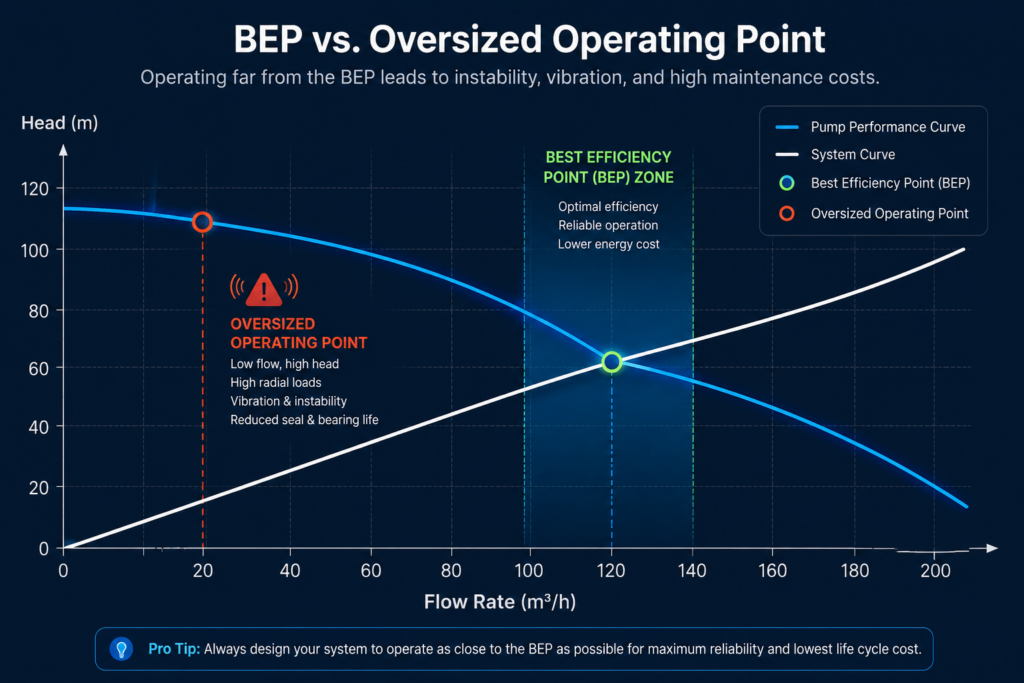
The critical metric in this evaluation is the Best Efficiency Point (BEP). The BEP represents the specific operating point on a pump’s performance curve where it runs most efficiently. When a system curve intersects with a pump curve far outside this optimal zone, the pump is forced to operate inefficiently. Operating an oversized pump pushes its performance far to the left of the BEP. This mechanical misalignment induces severe flow recirculation, generates excess heat, and creates damaging mechanical vibration.
Technical Evaluation
Early Detection: How Can I Recognize Signs That My Selected Pump is Oversized?
Field observations and vibration analysis can quickly diagnose an oversized centrifugal pump. Recognizing the physical symptoms of equipment running off-curve is critical for reliability engineering.
Common indicators include:
Acoustic Anomalies: Specific vibration noises are primary indicators that a pump is operating outside its acceptable region.
Component Failure: Premature bearing failure timelines frequently point to oversizing.
Seal Degradation: Mechanical seal failure is a direct consequence of the physical stresses introduced by off-curve operation.
Structural Stress: Shaft deflection occurs due to uneven pressure distributions inside the volute.
Hydraulic Issues: Deadheading and cavitation symptoms manifest when flow rates are improperly managed.
Option Comparison
System Optimization: Should I Use a Variable Frequency Drive (VFD) Instead of a Larger Pump?
When an oversized pump is identified, engineering corrections must be evaluated based on life-cycle assessment and energy conservation.
| Correction Method | Engineering Mechanism | Pros / Cons |
|---|---|---|
| Variable-Frequency Drive (VFD) | Controls motor speed based on Affinity Laws to adjust pump output. | Highly efficient for variable demand; however, it is not a universal cure-all for fundamentally mismatched equipment. |
| Impeller Trimming | The mechanical reduction of the impeller’s outer diameter. | Permanently reduces flow and head to shift the pump back toward its BEP without replacing the unit. Valid only for slightly oversized pumps. |
| Discharge Valve Throttling | Reduces flow rate by closing a discharge valve. | Introduces artificial system friction. Highly inefficient as an operational drain. |
| Smaller Pump Installation | Complete replacement with right-sized equipment. | Maximizes equipment reliability and service life. Highest initial capital expenditure. |
Risk Control
To prevent receiving subpar or improperly specified equipment, robust quality control and risk mitigation strategies must be implemented during production.
Quality Risk Assessment: List historical high-frequency defects in casting, machining, or assembly stages, such as sand holes, porosity, or poor sealing.
Preventive Measures: Require the factory to provide targeted Failure Mode and Effects Analysis (FMEA) for identified risks.
Production Monitoring: Closely monitor the impact of power restrictions, core equipment failures, or environmental inspections on factory capacity to prevent bottleneck delays.
Pre-Production Inspection (PPI): Confirm material status and First Article (FA) conditions before mass production.
During Production (DUPRO): Conduct spot checks to ensure dimensional consistency during the machining process.
Pre-Shipment Inspection (PSI): Verify final dimensions, appearance, functional test results, and packaging specifications against AQL standards.
Procurement Preparation
Procurement officers must establish a strict baseline for supplier selection and technical confirmation to secure reliable industrial fluid equipment.
Supplier Selection: Evaluate suppliers based on cross-border B2B trade experience, ISO compliance, and the ability to handle complex custom orders.
Factory Audits: Verify 5S management levels, actual core process capacity, lab equipment calibration, and check for unauthorized subcontracting.
Drawing Review: Require the supplier’s engineering team to sign off on tolerances, material specifications, surface treatments, and assembly interference points.
Material Certification: Mandate Material Test Certificates (MTC) and third-party spectral analysis reports for materials like stainless steel to prevent unauthorized substitutions.
Lead Time Management: Reject vague delivery estimates and demand a Gantt Chart detailing procurement, first article debugging, mass production, surface treatment, and final inspection, with a 10% to 15% buffer.
Packaging Specifications: Contractually mandate fumigation-free wooden crates, moisture-proof vacuum bags, rust prevention, and internal shock absorption for international shipping.
ROFLOW Recommendation
To ensure long-term value, prioritize right-sizing fluid equipment during the initial design phase. Operating an oversized pump guarantees energy waste and accelerates mechanical wear. If an existing pump is oversized, evaluate impeller trimming for minor deviations or implement VFD control based on precise system curves to restore operational efficiency and extend service life.
What is the Best Efficiency Point (BEP), and why does it matter for oversized pumps?
The BEP is the specific operating point on a pump’s performance curve where it runs most efficiently. Oversized pumps frequently operate far to the left of their BEP, leading to flow recirculation, excess heat, and mechanical vibration.
Can't I just throttle a discharge valve to manage an oversized pump?
While throttling reduces the flow rate, it introduces artificial system resistance (friction). The pump continues to consume high amounts of energy to overcome this resistance, making it an inefficient, long-term operational drain.
What is impeller trimming, and can it correct an oversized pump?
Impeller trimming is the mechanical reduction of the impeller’s outer diameter. It is a valid engineering correction for slightly oversized pumps to permanently reduce the flow and head, thereby shifting the pump back toward its BEP without replacing the entire unit.
Does an oversized pump use more electricity?
Yes, oversized pumps operate inefficiently and consume significantly more energy to overcome artificial system resistance when throttled.
Need a Custom Pump Configured for Extreme Conditions?
Send us your fluid viscosity, flow rate, and temperature limits. Our independent engineers will audit your specs and secure your supply chain.
Related Articles
Selecting the correct pump specifications for RO applications